

The Wednesday HOT TAKE
December 10 | Demand vs. Supply: The Divergence Defining Corn and Soybeans

Reminder: This will be the last HOT TAKE sent via Substack, as updates will soon be moving to NoBullAg.com.
Your current subscription will NOT be impacted — updates will continue to hit your inbox each week just as they do now.
The only change is all archives and subscription management will transition to NoBullAg.com, plus No Bull is also gearing up to launch the new Pro+ tier for those wanting deeper insights and expanded research.
More details coming end of this week.

In this week’s HOT TAKE, we are digging into the widening split between corn’s demand-driven momentum and soybeans’ increasingly burdensome supply as Brazil gears up for another record crop.
Plus, I will hit on the new $12B “bridge” package and why aid remains one of the most market-distorting tools in D.C.’s arsenal.
What’s HOT
Corn Exports
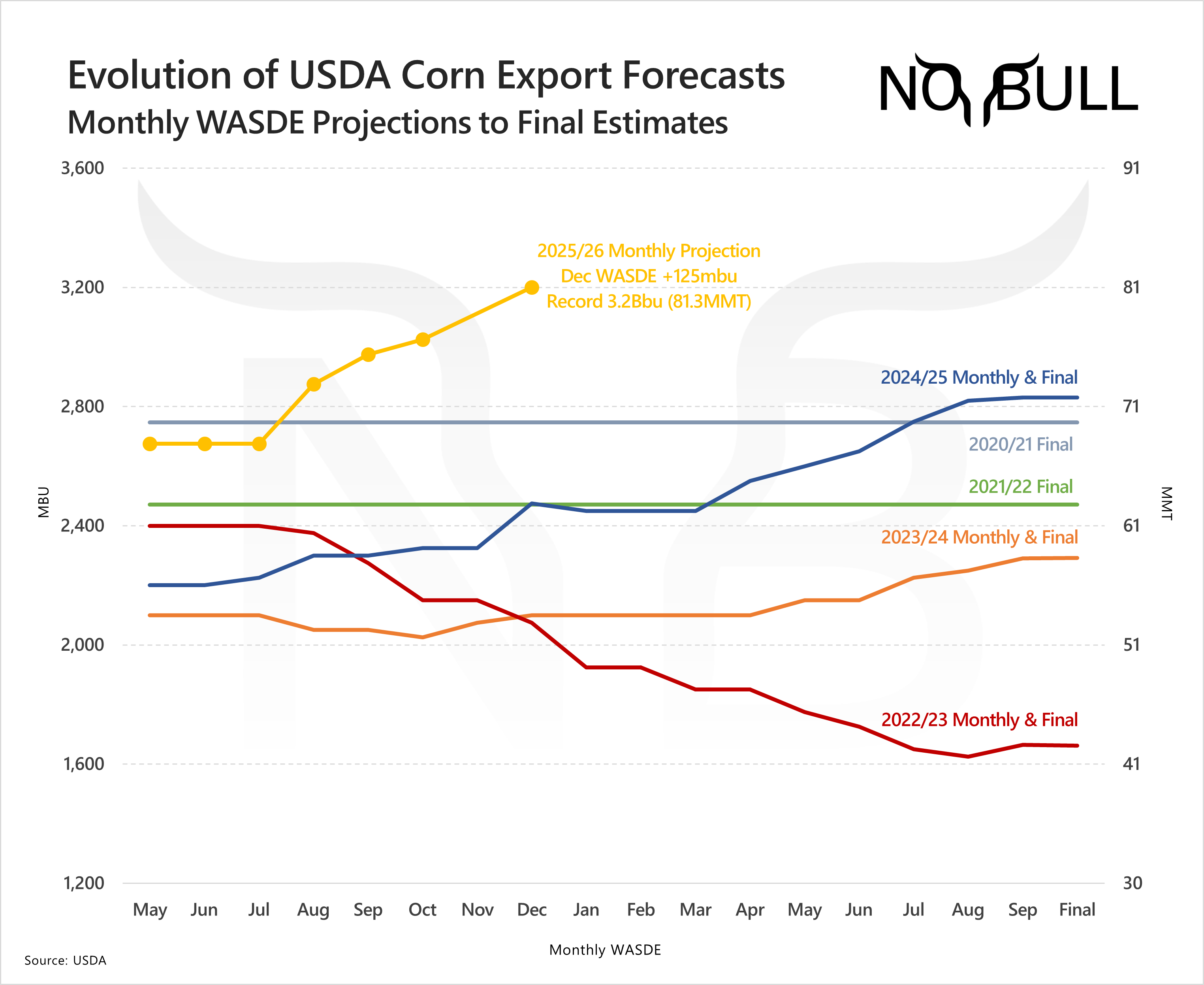
USDA raised its 2025/26 corn export projection another 125 mbu in Tuesday’s December WASDE to a record 3.2 bbu (81.3 MMT), citing record early-season inspections.
U.S. corn exports hit a historic 2.83 bbu (72.6 MMT) in 2024/25 and are off to another record start in 2025/26, as the U.S. captures a larger share of global trade.
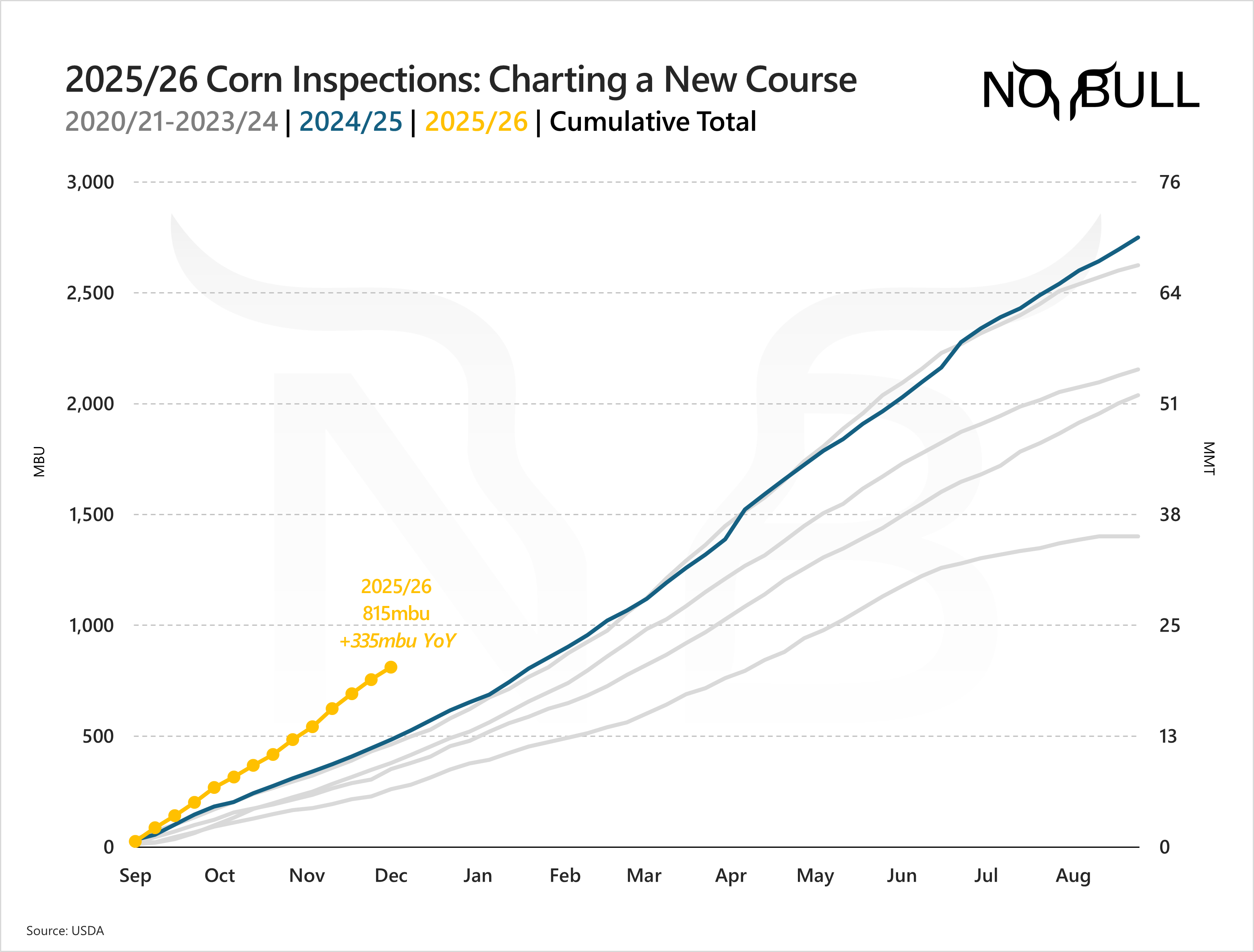
Low prices cure low prices in the form of new demand, and a record U.S. crop has amplified that effect — helping the U.S. regain global market share for the second straight year while competitors struggle.
Brazil’s strong domestic pull, Ukraine’s drought-hit crop, and slow shipments opened the door in 2024/25, and similar constraints abroad are supporting U.S. business again this year.
Meanwhile, China’s Q1 absence from the U.S. soybean market left early-season capacity in the PNW — capacity that corn has been more than willing to fill.
Yes, the U.S. is exporting more corn — but so is the rest of the world.
Global corn exports have surged over the past two decades, driven first by the mid-2000s ethanol boom — which redirected more U.S. corn into fuel — and then by rising incomes and stronger feed demand across emerging markets.
World trade jumped from roughly 70 MMT (~2.75 bbu) in the late 1990s to nearly 100 MMT (~3.9 bbu) by the late 2000s, while Brazil and others massively expanded production and export capacity to meet that growth.
